
03 Sep 2026


.webp)


The explosive growth of artificial intelligence is transforming the way data centers consume power. The challenge is no longer simply providing enough energy, it is managing how quickly demand can change. In a recent technical blog, NVIDIA described AI factories as a new class of infrastructure designed to"manufacture intelligence at scale," noting that power is increasingly becoming a control, quality, and interconnection challenge, not simply a capacity challenge. As AI campuses continue to grow in size and complexity, battery energy storage systems (BESS) are emerging as critical assets for managing dynamic loads, supporting grid stability, and enabling faster deployment of large-scale AI infrastructure.
For data center developers, utilities, and power providers, one challenge stands above the rest: rapidly changing AI load profiles.
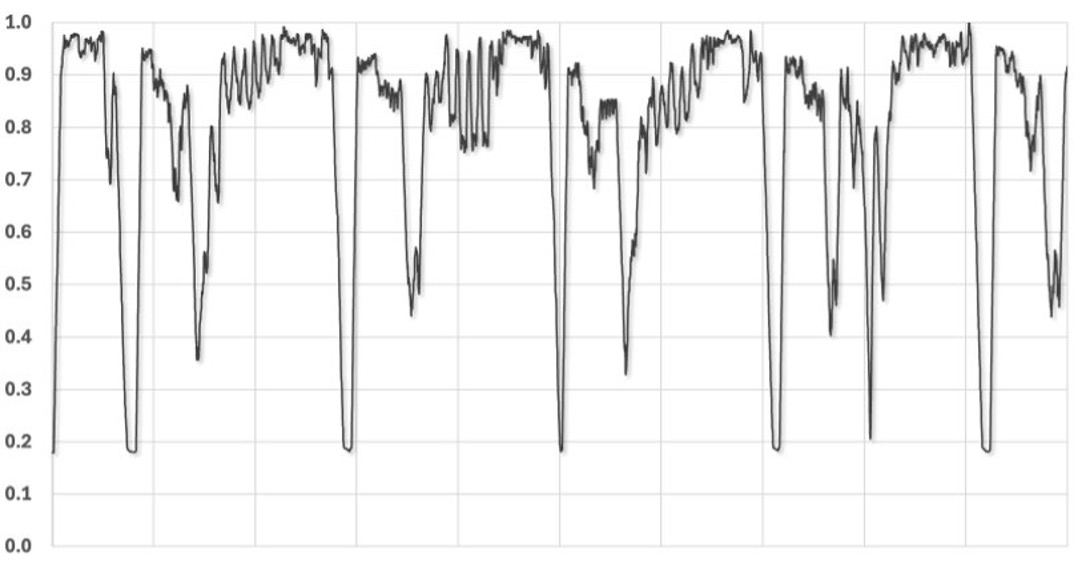
Unlike traditional industrial facilities, AI workloads can producedramatic swings in power demand within fractions of a second.
While the AI-style load profiles vary across different projects, manyinclude power ramps approaching 80% over extremely short time periods. Theserapid changes can impact generators, utilities, interconnection approvals, andoverall system stability.
The consequences can include:
· Degradedpower quality.
· Generatorstress caused by torque pulsations.
· Increasedrisk of interconnection delays or capacity limitations.
· Exposureto new mandatory ride-through, ramp-rate, and load-smoothing requirements nowbeing adopted by regulators and utilities.
As a result, utilities are increasingly evaluating not only how much power a facility consumes, but how that facility behaves as a load connected to the grid.
This urgency is no longer theoretical. On July 16, 2026, FERC directed NERC to develop mandatory Reliability Standards for"computational loads", the same AI data center facilities behind the load swings described above, after NERC catalogued grid disturbances in which computational loads lost a large share of their consumption within milliseconds of a routine transmission fault. NERC, which has been building this framework through its Large Loads Working Group (LLWG), escalated to a Level 3 Essential ActionAlert in May 2026, its highest-urgency category, with compliance responses due from registered entities by August 3, 2026.
Grid operators and utilities are moving in parallel. In ERCOT,NOGRR282 and NPRR1308, approved by the Public Utility Commission of Texas inJune 2026, impose new voltage and frequency ride-through requirements on LargeElectronic Loads of 75 MW or more, and ERCOT's Large Load Working Group continues to develop dynamic modeling and smoothing expectations. Individual utilities are moving at the tariff and contract level as well, including items such as ramp rate limitations based on frequency components, curtailment protocols, and other load-smoothing obligations.
Taken together, these actions mark a shift from voluntary best practice to enforceable compliance. Load-smoothing performance is becoming a condition of interconnection and service, not just an operational nice-to-have, which raises the stakes for data center compliance.
The industry already has a tool for managing dynamic transients on the grid: grid-forming battery energy storage systems.
Modern grid-forming inverters respond within a millisecond to changes in voltage and frequency, helping stabilize the system and absorb fluctuations. This capability has made grid-forming architectures increasingly important for data centers, micro grids, and large-scale energy infrastructure.
In this mode, however, the inverter still shares the load with the grid or generator. As AI workloads become more dynamic, sharing is not sufficient in itself. The issue is no longer whether the battery system responds.
The issue is how quickly the BESS can offset the entire load ramp.
In traditional architectures, higher-level control systems oftendetect load changes, process the information, and then send commands back tothe battery system.
While effective for many applications, these communication pathwayscan introduce delays exceeding 100 milliseconds.
For conventional BESS use cases, that delay may not be significant. However, for AI workloads capable of changing dramatically in fractions of a second, it matters.
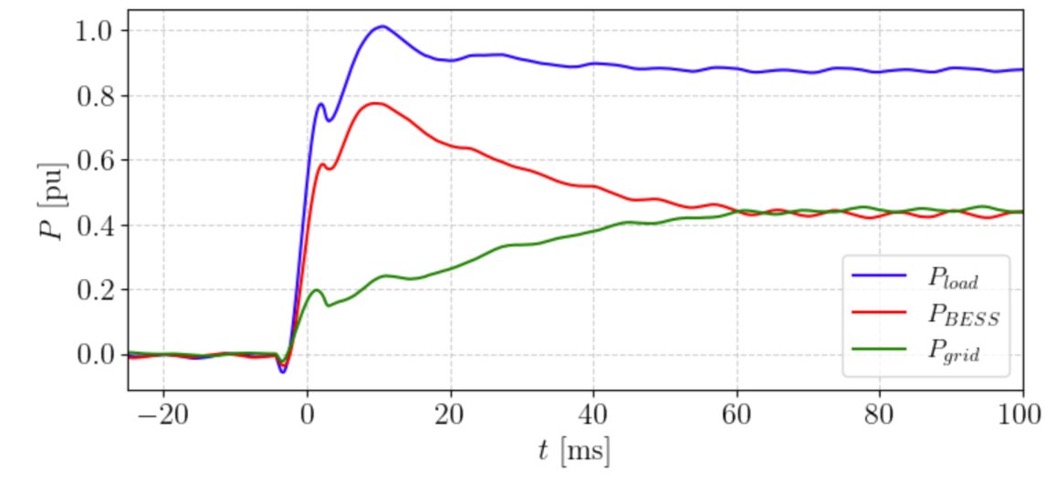
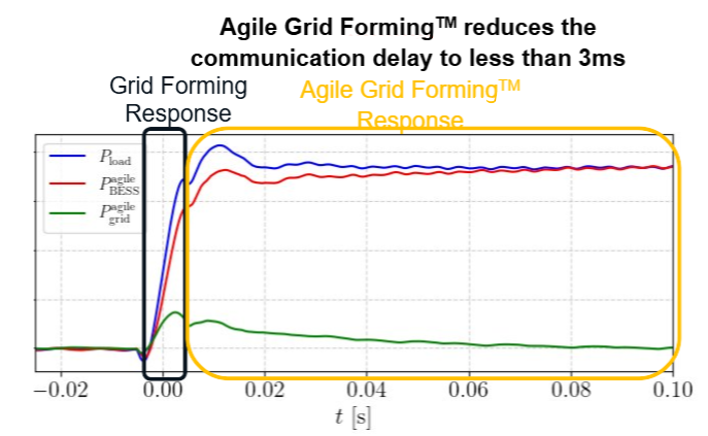
By the time a traditional control architecture receives the signal, processes the event, and sends a response command, much of the disturbance has already propagated through the electrical system. This graph shows a typical response where the load power demand is shared between a grid-forming BESS and a grid. After 100ms, the BESS is commanded to offset the entire load. The issue is the grid still pics up 40%-50% of the load for the 100ms after the load ramps.
EPC Power developed Agile Grid Forming™ to address that challenge.
At the center of the architecture is EPC Power's Agile Measurement Node (AMN), which measures voltage and current directly at the load and communicates those measurements directly to the inverter. Instead of relying on traditional supervisory control paths, the system creates a direct and highly responsive control loop.
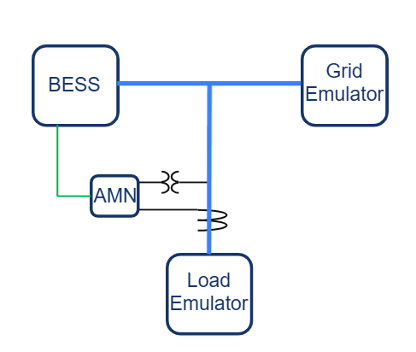
The result is simple but significant:
· Traditional communication pathways: typically greater than 100 ms.
· Agile Grid Forming™: less than 3 ms.
That means Agile Grid Forming™ can respond more than 30 times faster than conventional architectures.
Rather than waiting for the event to pass through the electricalsystem, the battery can react while the event is occurring.
That difference in speed allows the system to smooth load changes more effectively, helping present a more stable profile to utilities, generators, and interconnection infrastructure.
To test the effectiveness of Agile Grid Forming™, EPC Power conducted laboratory testing using highly dynamic load profiles representative of those found in AI environments. Testing demonstrated communication response times of less than 3 milliseconds while validating the benefits of combining direct load measurements with advanced grid-forming controls.
The result is a system capable of reacting significantly faster than traditional architectures while improving overall load-smoothing performance.
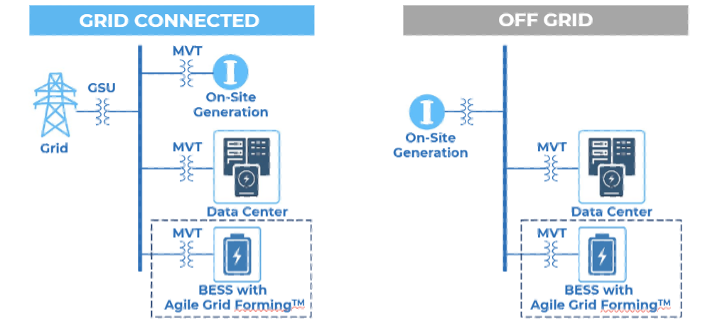
Agile Grid Forming™ is not dependent on a particular interconnection and can work on a strong utility grid, weak utility grid, and/or with on-site generation.
The technology can be deployed across a range of environments including:
· Utility-connected data centers.
· Sites with onsite generation.
· Hybrid on-site and utility-connected systems.
This flexibility gives developers more options as they seek to support growing AI loads while navigating grid constraints.
AI infrastructure is quickly moving from a power-availability question to a power-performance challenge. As a facility’s demand changes, the electrical system needs to change as well, so that it can absorb fast-changing demand without passing that volatility upstream.
That is where the speed of the control architecture becomes decisive.
By moving response closer to the load, EPC Power’s Agile GridForming™ technology gives battery systems the ability to act before a disturbance has time to spread through the site or interconnection.
For AI campuses, that shift can translate into a more manageable operating profile for utilities, generators, developers, and facility teams—supporting faster deployment and more confident integration of large, dynamic loads.
Want to learn more: Contact Jason Barmann (jason.barmann@epcpower.com)