
03 Sep 2026


.webp)


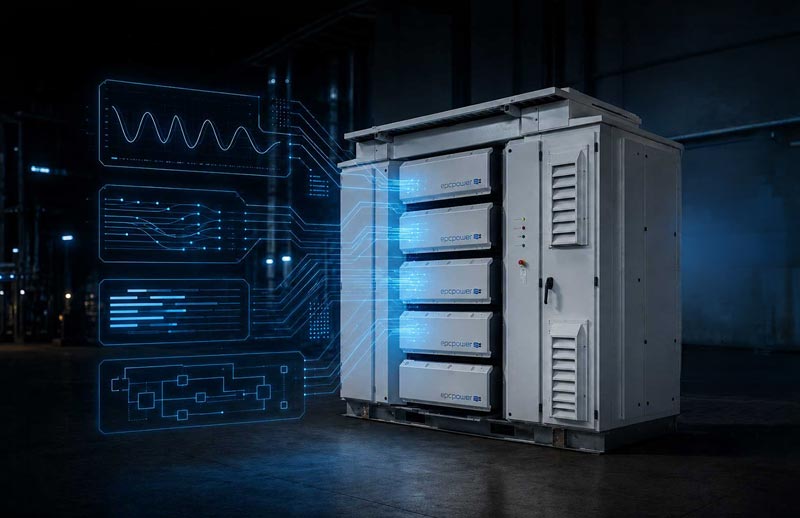
Traditional data center design has fundamentally changed to meet the increased power demand of AI data centers. AI has also introduced electrical challenges that traditional infrastructure is not equipped to handle. One issue in particular has been identified as a major risk to construction timelines and meeting utility/on-site generation requirements: the highly erratic power consumption of AI training loads. Existing solutions, including battery or flywheel-based UPS systems as well as other frequency stabilizing technology, may not always provide the speed or flexibility needed to fully address these concerns. To bridge this gap, EPC Power has developed an innovative agile grid forming approach designed specifically for the fast-changing needs of AI facilities.
Modern AI training clusters generate power profiles that fluctuate far more aggressively than traditional compute loads. High-density GPU servers can swing their power consumption levels within milliseconds, creating instability that propagates through the power distribution system and into the surrounding grid. These fast ramps not only degrade power quality but can also introduce harmful mechanical stresses to onsite generation resources, such as gas turbines and reciprocating engines.
These power swings can be mitigated at several points. Rack level buffering, often based on supercapacitors, can absorb the fastest fluctuations, but can be expensive and takes up valuable data hall space. Because these technologies only cover extremely short durations, additional storage is typically needed to reduce the remaining volatility to levels acceptable for generating equipment and utility standards. This short-duration limitation is also a challenge for other technologies, such as flywheels, UPS, or other voltage/frequency stabilizing systems.
When looking at longer duration solutions, battery energy storage systems (BESS) can be integrated into 3MW blocks to 100MW+ systems, providing the scalability data centers require. More advanced grid-forming BESS are capable of response within milliseconds to deviations in voltage and frequency caused by load changes. The challenge with traditional grid-forming BESS is that their effectiveness depends heavily on grid strength and other onsite generation resources that may pick up some of the load transient. In the best cases, they may mitigate only a portion of the disturbance, leaving significant volatility unaddressed.
To come online faster, several data center sites will be powered solely by on-site generation for the first few years, then transition to a grid interconnection for the rest of the facility’s life. Any solution deployed to mitigate the AI load ramps needs to be effective in both scenarios.
EPC Power’s Agile Grid Forming technology represents a more responsive evolution of these systems. It retains the benefits of millisecond grid-forming response without relying solely on voltage and frequency deviations to ramp its power output to offset the fluctuations at the data center power interconnection. It’s designed to smooth a larger portion of the load than traditional grid-forming control but is able to work whether the data center is powered by on-site generators or connected to a strong utility grid.
With AI growth pushing power systems into uncharted territory, the industry needs solutions that can react quickly, provide robust grid support, and integrate into both on-site generation and utility networks. EPC Power’s Agile Grid Forming BESS offers a path forward by delivering precise load smoothing and disturbance ride-through capabilities that go beyond what many traditional approaches offer. As data center projects navigate the evolving requirements for large digital infrastructure, technologies like this will play a critical role in enabling the next generation of AI-driven data centers.